The Modernist Studies Association is excited to announce its short list for the MSA First Book Prize for a book published in 2025. Many congratulations to everyone who published books last year and to the finalists below.
2026 MSA First Book Prize Shortlist (for books published in 2025)
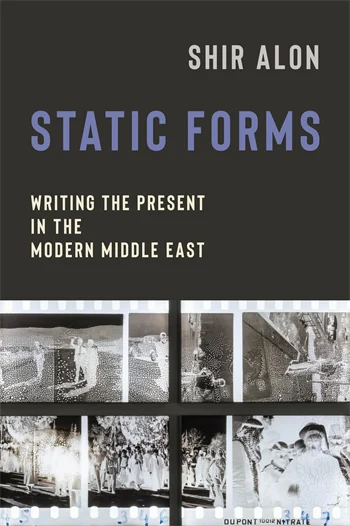
WINNER: Shir Alon, Static Forms: Writing the Present in the Modern Middle East
(Columbia UP, 2025))
Static Forms is a challenging and evocative study of literary modernity and its variable tempos and tenses in Arabic and Hebrew writing. These literatures, Alon contends, have a “parallel trajectory,” especially apparent in shared discourses of cultural revival. The tension between novelty and literary-cultural inheritance exerts a paradoxical effect on these literatures: their modernism expresses distinct “formal solutions [that] emerge in relation to the lived experience of the modern present” while also engendering what Alon terms “static forms.” Alon’s chapters offers sophisticated theorizations and subtle readings of such forms, which appear as reverb, repetition, and other kinds of suspended or compulsive relations to time and action in the work of writers including Shmuel Yosef Agnon, Mahmud al-Mas’adi, Sonallah Ibrahim, Yeshayahu Koren, and Adania Shibli. In a gripping chapter, Alon brilliantly reads recurring figures of scratching and scraping in the work of Fathi Ghanem and Yosef Haim Brenner as critical engagements with national imperatives about productivity and settlement. Static Forms is an erudite and sensitive work of comparative scholarship, tracing shared developments while resisting false equivalences. Alon’s readings are attuned to the ways that her Arabic texts are enmeshed in projects of postcolonial nation building and her Hebrew texts implicated in Israeli settler colonialism. In the final chapter, on Shibli’s novel Touch, Alon poignantly examines the temporality of the suspended present in light of the ongoing Nakba and the condition of Palestinian dispossession.

Nicoletta Asciuto, Brilliant Modernism: Cultures of Light and Modernist Poetry (Johns Hopkins University Press, 2025)
This compelling and multidisciplinary study shows how changes in illumination technology at the turn of the twentieth century shaped modernist poetics and visual arts, exploring how a group of “brilliant modernists” such as T. S. Eliot, Filippo Marinetti and Mina Loy drew upon the shifting cultural meanings of light and illumination to articulate their own status as moderns. Brilliant Modernism demonstrates how as simple an act as lighting a candle, or walking a city’s streets, could feel new, strange, and even liberating given the new forms of artificial illumination emerging at this time. Asciuto reveals how this “bright new aesthetic” not only reorganized longstanding poetic metaphors about light and dark, but also “sparked revolutionary ideas about gender,” as a figure like Loy took symbolic moons and real lamps as means to throw light on ideas about erotics, domesticity, and her own evolving creative practices as a woman writer.
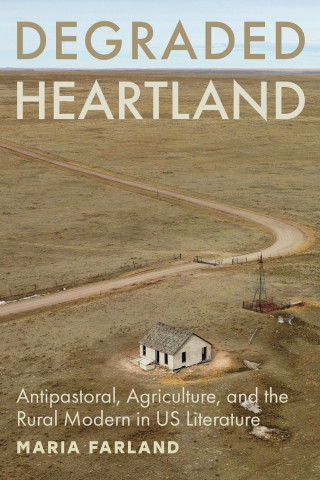
Maria Farland, Degraded Heartland: Antipastoral, Agriculture, and the Rural Modern in US
Literature
(Johns Hopkins University Press, 2025)
Degraded Heartland offers our “first book-length study of US antipastoral,” a literary mode that confronted the widespread notions about rural degeneration and ambitions for agrarian reform which began circulating in the mid-nineteenth century. Through sweeping historical research, Farland shows how writers from Dickinson and Whitman to Frost and Toomer were intimately familiar with rural environments being threatened by overextraction, and with rural populations who were pathologized as “backwards,” while also gathering a neglected archive of immigrant farm fiction that dramatizes the clash between capital’s need to mobilize labor for settling new lands grated and American xenophobia. Farland’s learned study incorporates unforgettable biographic details, like Emily Dickinson winning a county prize for best rye bread, or Frost first publishing in poultry magazines, to launch a major recontextualization of these modern writers within a set of anxieties about rural spaces and peoples that remain distressingly significant even today.

Atreyee Gupta, Non-Aligned: Art, Decolonization, and the Third-World Project in India
(Yale University Press, 2025)
In Non-Aligned, Atreyee Gupta enriches familiar histories of decolonization, the Bandung Conference, and midcentury dreams of third world solidarity by demonstrating how these political aspirations spurred the formally challenging and restlessly experimental work of a marvelous array of artists in India, including Abanindranath Tagore, Jeet Malhotra, Dhanraj Bhagat, Jagdish Swaminathan, and Francis Newton Souza. Through astute close readings of their work, as well as meticulous research into materials such as preparatory studies and notes, Gupta reconstructs the centrality of Afro-Asian and other internationalist affiliations for these artists in the years before and after Bandung. Painting and collage are central, but so too are architecture, photography and sculpture, as in the expansive chapter on the planned city of Chandigarh, which considers the aesthetics of industrial materials like concrete in an era of international abstraction and postcolonial ideologies of development and infrastructure at home. In Gupta’s canny analysis, non-alignment takes on a double meaning: not just the political posture of decolonizing nations caught between Cold War superpowers but also a figure for an Indian modernist aesthetics that took its cues from anticolonial struggle rather than from forms and debates disseminated from Europe or America.

Sebastian P. Klinger, Sleep Works: Experiments in Science and Literature 1899-1929 (Johns Hopkins University Press, 2025)
Readers will never see Proust the same way after absorbing Sebastian P. Klinger’s lucid and engaging study of experimental sleep research and its intersection with 20th century literature. Opening with science but ending with poetry, the book reads familiar modernist literary works anew by attending to their engagement with sleep beyond the well-trodden psychoanalytic territory of dreams. Rather, Klinger’s approach encompasses pathologies such as insomnia and encephalitis lethargica and new sleep technologies ranging from the sedative Veronal to the “electroencephalograph,” a machine that records the alpha rhythms of a person at rest. Historicizing the surprising labor involved in simply going to bed (and staying there), Sleep Works offers riveting, fresh analyses of the works of Kafka, Proust, Rilke, and Schnitzler, digging into the archives of German corporate pharmaceutical giants Bayer and Merck via these companies’ European archives (a highlight is Klinger’s discovery of Bayer’s records regarding Arthur Schnitzler’s story of a Veronal poisoning in Fräulein Else). Klinger’s examples of all of the different ways slumber was becoming fatefully “taylorized” during these decades are enough to keep one up at night.
Nominating Committee:
- Sonali Thakkar (New York University) (Chair)
- Ian Afflerbach (University of North Georgia)
- Beth Blum (Harvard University)
About
Each year, the Modernist Studies Association seeks nominations for
its First Book Prize, awarded to a first book published in the
previous year. A panel of judges determines the book that made the
most significant contribution to modernist studies. A book initially
published in another year will not be eligible for the prize. This
exclusion applies even if a new edition (paperback or revised, for
example) was published in the award year.
Please visit our Nominations page in Spring 2027 to recommend a book(published in 2026). Visit our Archive to see previous winners.