The Modernist Studies Association is excited to announce its short list for the MSA Book Prize for a book published in 2025. Many congratulations to everyone who published books last year and to the finalists below.
2026 MSA Book Prize Shortlist (for books published in 2025)
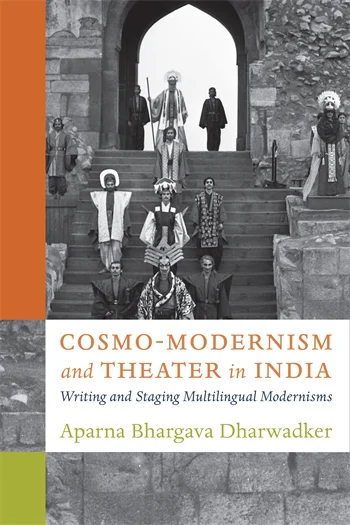
WINNER: Aparna Bhargava Dharwadker, Cosmo-Modernism and Theater in India: Writing and Staging Multilingual Modernisms (Columbia University Press, 2025)
Refining arguments on global and planetary modernisms by focusing on the India’s rich multilingual dramatic tradition, Aparna Bhargava Dharwadker traces the ways prominent mid- to late-twentieth-century playwrights such as Dharamvir Bharati, Vijay Tendulkar and Girish Karnad enacted a break from colonial-era theatrical forms. Her careful attention to the writing, staging and reception of plays shows how playwrights’ negotiations of Indian tradition, precolonial techniques and the postcolonial created new modernist modes of Indian classicism and realism. Her focus on how noncommercial theatre and the constant activity of translation required by regional, national and transnational circulation shines important new light on modernist drama and global modernisms.

Shiben Banerji, Lineages of the Global City: Occult Modernism and the Spiritualization of Democracy (University of Texas Press, 2025)
In this strikingly original study, Shiben Banerji shows how modernists influenced by esoteric movements planned urban spaces to nurture a new global consciousness. With various occult interests, particularly in Theosophy, designers in Europe and the Americas, Australia and South Asia conceived of urban planning as a counter to the twin threats of international socialism and liberal internationalism. Analyzing the films, drawings, writing and prints comprising city plans, Lineages of the Global City guides us through the fantastic ideals and late-colonial compromises of these interconnected scenes. It is a remarkable book, furthering in unexpected ways the reappraisal of the relationship between modernism and the occult movements of the early twentieth century.

Kristin Bluemel, Enchanted Wood: Engraving a Place for Women Artists in Rural Britain (University of Minnesota Press, 2025)
Enchanted Wood is visually arresting recovery of the overlooked story of four women wood engravers. These craftswomen flourished during Depression-era British publishing, where they illustrated children’s and adult’s books by reworking Thomas Bewick’s eighteenth-century naturalist print traditions for modern reflections on gender, marriage and motherhood. Providing richly reproduced engravings, drawings and rare colour prints, Kristin Bluemel’s work enables readers to experience the ways these gentle arts facilitated professional standing and personal independence for these women. In so doing she presents Gwen Raverat, Agnes Miller Parker, Clare Leighton, and Joan Hassall as significant modern artists and literary figures.
Kevin Ohi, Narrative Personae and Desire in Modernist Fiction (Oxford University Press, 2025)
Kevin Ohi trains a judicious eye on the relationship between narrators and characters in modernist fiction, tracing the emergence of the narrative ‘quasi-person’ as the expression of an all-too-human desire. Resisting both the untechnical treatment of literary characters as ‘real’ subjects and an anti-subjective denial of interiority itself—reading practices that distort modernists’ own conceptions of their literary projects—the book encourages careful reading. It allows us to hear anew the strange narrative voices of canonical modernists such as Virginia Woolf and William Faulkner while encouraging a fresh appraisal of neglected authors including Ronald Firbank and James Purdy, who emerge not only as seminal queer writers but also meticulous narrative stylists. Well-read and beautifully crafted, it celebrates the aesthetic pleasure afforded by close attention to modernist prose.

Anna Snaith, Writing Noise in Interwar Britain: Literature and the Politics of Sound (Oxford University Press, 2025)
Anna Snaith’s brilliant reading of the ‘age of noise’ focuses critical attention on the soundscape of interwar Britain. From the screams of First World War bombs to the harmonics and discords of street performers, from the blaring static of radio sets to the shrill control of industrial sirens, from sonic nationalism to sonic healing, Snaith focuses our attention on modernist writers’ fascination with the cacophony of modernity. Her analyses astutely remind us that close reading is close listening, and as she trains her ear on Virginia Woolf, Elizabeth Bowen, and Dorothy L. Sayers as well as George Orwell and Claude McKay she shows the epistemological shifts that arise when we heed the sounds of the city, as well as the sounds of the sentence.
Nominating Committee:
- Matthew Hayward (University of Waikato) (Co-Chair)
- Maebh Long (University of Otago) (Co-Chair)
- Adam McKible (John Jay College, CUNY)
About
Each year, the Modernist Studies Association seeks nominations for
its Book Prize, awarded to a book published in the
previous year. A panel of judges determines the book that made the
most significant contribution to modernist studies. A book initially
published in another year will not be eligible for the prize. This
exclusion applies even if a new edition (paperback or revised, for
example) was published in the award year.
Please visit our Nominations page in Spring 2027 to recommend a book (published in 2026). Visit our Archive to see previous winners.